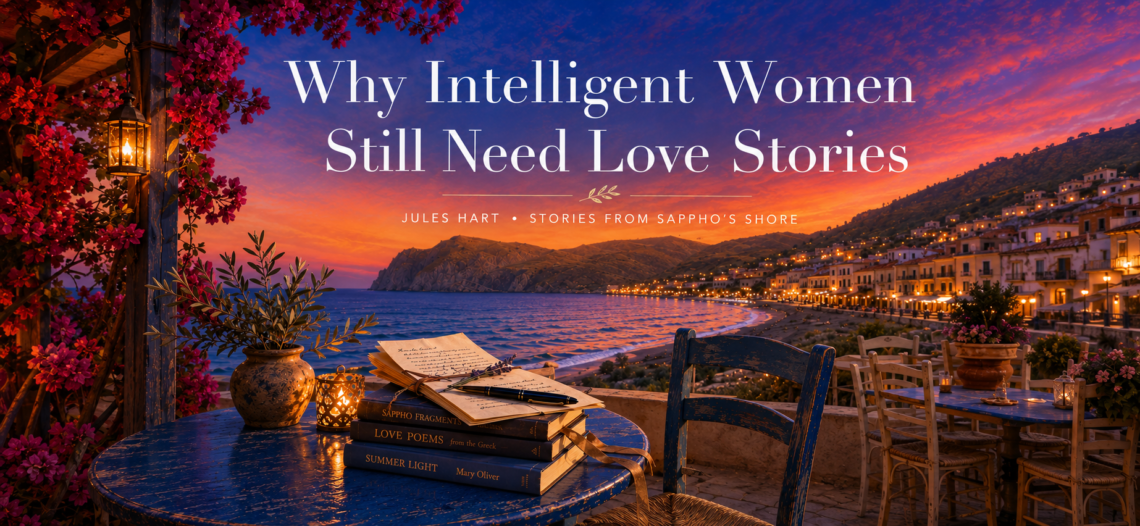
Why Intelligent Women Still Need Love Stories
At some point, many intelligent women were handed an invisible hierarchy of reading.
Serious books went at the top. Love stories were placed somewhere lower down, beside chocolate and other pleasures we were apparently allowed only if we called them guilty.
I have never understood the guilt.
A woman can follow world affairs, run a company, quote Sappho and still care very much whether two fictional women manage to kiss before one of them does something catastrophically noble. The heart is not the remedial class of the mind.
This is especially true for readers looking for lesbian romance with emotional depth: stories that offer pleasure without insulting our intelligence, and hope without pretending adult life is simple.
Love Is Not the Easy Subject
Love is one of the most demanding subjects a writer can choose, because it drags almost everything else into the room with it.
Grief comes. So do pride, money, age, family, power, sex, duty and the inconvenient fact that two people can want each other deeply while being spectacularly unsuited to honesty.
A good love story is not merely asking, Will they get together? It asks what these women must understand, risk or surrender before they can be fully known—and whether they can make room for somebody else without disappearing into her.
The kiss matters, naturally. I am not proposing we remove it and replace it with a seminar. But the kiss should carry the weight of everything that came before it. Otherwise it is just two mouths arriving at the same appointment.
Where Were the Women Like Us?
For lesbian readers, the problem has rarely been an excess of rich, varied love stories.
Many of us grew up searching for ourselves in footnotes, subtext and women who lived together for forty years while the narrative insisted they were exceptionally devoted friends or “companions”. When lesbian characters did appear, they were often very young, very tragic, or required to spend the entire book discovering something the reader had known since page three, not to mention being killed off as a favourite trope.
But so do women who have already lived.
Women with careers, ex-lovers, ageing parents, old loyalties and bodies that have acquired both history and opinions. Women who have survived loss, burnout or the slow accumulation of choices that once seemed sensible. Women who are not waiting for romance to make them interesting.
They were interesting before she arrived.
That is why lesbian romance novels for mature, arrived, readers matter. They allow women over thirty-five, forty, fifty and beyond to occupy the centre of desire rather than its respectable outskirts or undershirts. We are not past love. We are finally complicated enough for a really good story.
Why a Happy Ending Is Not a Stupid Ending
Romance is sometimes dismissed because readers expect the central couple to end together. This seems an odd objection. We expect the detective to identify the murderer. Genre is a promise, not a confession of artistic failure.
The question is not only where the story ends. It is how honestly it gets there.
A convincing happy ending does not claim that love cures grief or ensures nobody will leave wet towels on the floor. It says that, after everything these women have learned and lost, they choose one another with their eyes open.
(Even though I must confess that some of my novels break these rules to prove the rules of life.)
Hope is not the absence of intelligence.
In fact, hope can be harder to write than despair. Despair only has to close the door. Hope must show us why somebody might open it again.
This is what draws me to second-chance lesbian romance. Not the fantasy that the past did not matter, but the more difficult possibility that it mattered enormously—and happiness may still be available.
The Kind of Stories I Want to Read—and Write
I want character-driven lesbian fiction in which both women possess a life beyond the relationship. I want wit alongside longing, because desire is frequently ridiculous. I want sensuality that reveals character rather than reading like furniture transferred from another book.
I want consent on the page and emotion before anatomy. I want queerness to be ordinary, not the problem requiring a solution. Let the conflict come from grief, fear, duty, timing, ambition or the stubborn human habit of saying “I’m fine” when the evidence has become almost insulting.
And even then, I want to break the rules and explore the what if of reality. The real responses, the real challenges and the real foibles of being human, wanting something different to the norm or dealing with the edge cases of love.
This is the territory of my Sappho’s Shore Collection.
Across the books, women arrive in and around Skala Eressos carrying lives that no longer fit quite as well as they once did. A grieving doctor must decide whether loving again betrays the woman she lost. A successful businesswoman discovers that competence is less useful when the negotiation is with her own heart. An astronomer who trusts evidence meets a musician who trusts the stars. Old love waits beneath an orange tree, where time has preserved rather more than either woman expected.
The island does not repair them. That would be convenient and rather alarming. It gives them room, community, sunlight and the occasional badly timed truth. What they do next is their own work.
Some readers may call this literary lesbian romance. Others may prefer mature lesbian romance, queer women’s fiction or simply books about women loving women. Labels are useful on shelves and less reliable in the heart. What matters to me is that the stories are warm without being flimsy, intelligent without becoming cold, and romantic without requiring either woman to lose her dignity.
Mostly.
Dignity can be difficult to maintain around an attractive woman in good light.
Pleasure Is Not the Enemy of Substance
A book may contain sea, sex, souvlaki and a sunset and still have something to say.
Sometimes a novel should transport us, make us laugh, tighten something behind the ribs and return us to our own lives a little less alone. Pleasure does not make a book shallow. Thin characters and false emotion do that perfectly well by themselves.
Intelligent women still need love stories because intelligence does not make us immune to longing. Experience does not cancel desire. Knowing that love cannot solve everything does not make it unimportant.
Quite the reverse.
We know what it costs.
That is the kind of love story I want to write: one that respects the reader, understands the women and makes the ending earn its pips. You are welcome to explore Sappho’s Shore from here. I shall be at my table in Skala Online, pretending not to notice which book you pick up first.

You May Also Like